

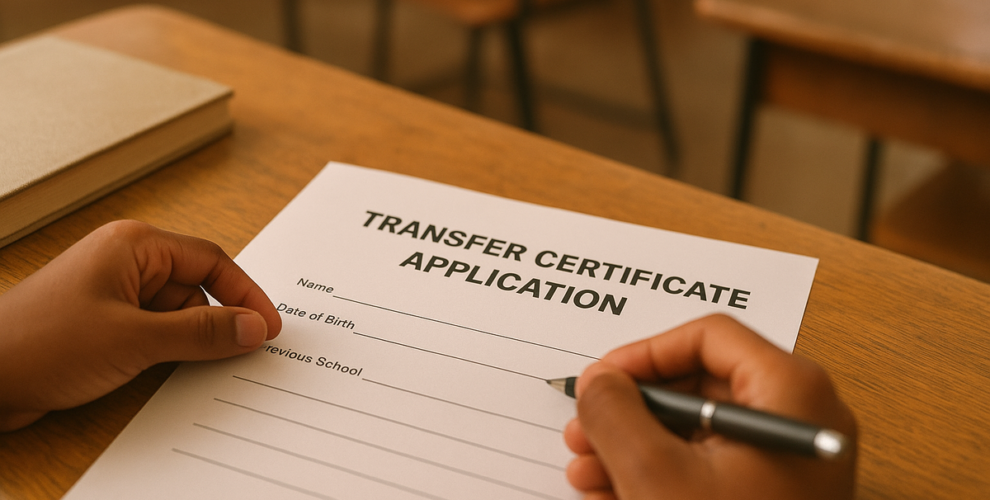
Every transfer season, the same confusion lands on our front desk. A parent asks for a “TC” when they actually need a Character Certificate. Or they ask for a Migration Certificate when a plain School Leaving Certificate would have moved the application forward faster. Our methodology for sorting this out at the counter is simple: identify which document the receiving school actually asked for, check it against what the family already has, and fill only the real gap. If you’re mid-transfer right now — relocating for a posting, moving between Kundli and another city, or switching your child from a state board to CBSE — this is that same walkthrough, written down so you don’t have to make a second trip to find out.
TC vs SLC vs Character Certificate vs Migration Certificate
These four documents get used interchangeably in everyday conversation. A receiving school’s admission office checks for them separately, though. According to the CBSE affiliation bye-laws, a school must issue a Transfer Certificate in the Board’s prescribed format whenever a student withdraws before completing a stage of schooling. The four documents are not substitutes for one another, even when a parent assumes they are.
| Document | What it actually certifies | When you need it |
|---|---|---|
| Transfer Certificate (TC) | Date of withdrawal, class last attended, and that dues are cleared | Moving to any new school, any board, mid-session or between sessions |
| School Leaving Certificate (SLC) | Same core data as a TC; the term some state boards and older records still use | State-board schools that haven’t adopted CBSE’s TC terminology |
| Character Certificate | Conduct record during enrolment — a behavioural reference, not a withdrawal record | Scholarship forms, some hostel admissions, occasionally requested alongside a TC |
| Migration Certificate | Confirms no other board currently has an active enrolment for that student | Only when moving between boards — CBSE to a state board, or CBSE to IB/ICSE, not within CBSE itself |
If a receiving school asks for “the TC” and you hand over a Character Certificate instead, the admission file gets kicked back. We see this roughly twice a month at our own counter. It costs the family another week of back and forth, and it’s almost always avoidable with five minutes of checking the table above before you walk in.
A copyable transfer certificate application letter
Address the letter to the Principal by name, if you know it. “The Principal” is fine if you don’t. Keep it to one page. Admission offices process dozens of these per week, and a letter that takes 30 seconds to read moves faster through the queue than one that doesn’t.
The Principal
[School Name]
[School Address]Subject: Application for issue of Transfer Certificate
Respected Sir/Madam,
I am the parent/guardian of [Student’s Full Name], currently studying in Class [X], Section [Y], with Admission/Roll Number [Number]. Due to [reason — e.g., relocation to another city/transfer of posting/change of board], I am withdrawing my child from [School Name] with effect from 2026.
I request you to kindly issue the Transfer Certificate along with the mark sheet and conduct record at the earliest, so that admission in the new school is not delayed. I confirm that all dues, including tuition and library dues, have been cleared / will be cleared on 2026.
Thanking you,
[Parent/Guardian Name]
[Contact Number]
[Date]
For a mid-session withdrawal, add one line after the reason. Write: “I understand this is a mid-session withdrawal and request the TC be dated to reflect the actual last date of attendance, not the session-end date.” Schools sometimes default to the session-end date out of habit. This single line prevents that, and it keeps the receiving school’s admission records accurate from day one.
Supporting documents and realistic turnaround
Before any TC leaves our office, the front desk checks four things. First, the signed application letter above. Second, the student’s last report card or mark sheet. Third, the original admission form or previous school’s TC, used to cross-verify the date of birth. Fourth, confirmation that fee dues are cleared through the current term.
Once the file is complete, our own turnaround at GD Goenka Sonepat runs 3 to 7 working days. It moves faster when dues are already settled. It runs slower when a fee reconciliation or a records cross-check is pending. Across the roughly dozen TC requests our office handles in a typical month, the single biggest delay isn’t paperwork at all — it’s a parent submitting the request with dues still outstanding, which pushes the whole file back to square one.
A short note on sequencing: submit the application letter and the dues clearance together, not one after the other. Families who submit the letter first and promise to clear dues “next week” routinely add 4 to 5 extra days to their own timeline, simply because the file sits incomplete in the queue until the second half arrives.
What a school can and cannot hold the TC for
This is the part parents are most often misinformed about. Per the CBSE affiliation bye-laws, a school may ask that fee dues be cleared before issuing a TC. That part is legitimate. What it cannot do is withhold the document indefinitely, charge a punitive “TC fee” disproportionate to actual administrative cost, or refuse issuance over a dispute unrelated to fees — a disciplinary disagreement, for instance, is not grounds to withhold a TC once dues are clear.
If a school is stalling past a reasonable processing window with dues already cleared, the bye-laws and most state education department circulars give parents ground to escalate to the Board’s Regional Office. In our own experience fielding questions on this exact point, most “withheld TC” cases turn out to be an unresolved dues balance rather than an actual refusal — it’s worth confirming that first before assuming the worst.
Source: CBSE’s own affiliation bye-laws document, which every CBSE school — including ours, affiliation number 531123 — is bound by: CBSE Affiliation Bye-Laws (PDF).
District Education Officer counter-signature — when it’s actually needed
A DEO counter-signature on a TC is not a routine requirement for every transfer. It becomes necessary in two situations. One: an interstate transfer, where the receiving state’s education department mandates attestation as part of its own admission verification. Two: a transfer that straddles a board change, where the new board’s affiliated school asks for it as extra confirmation.
A same-city, same-board transfer — the most common case we process at our own counter — almost never needs it. If you’re not sure whether your destination state requires it, the receiving school’s admission office will tell you before you make a trip to the DEO’s office for nothing. A quick phone call to the new school, placed before you travel anywhere, saves most families a wasted half-day.
Changing boards: state board to CBSE, and CBSE to IB or ICSE
Moving from a state board into CBSE is the single most common board-change case our admissions team sees from relocating families, year after year. The receiving CBSE school will typically ask for three things: the TC/SLC from the state-board school, the last two years of mark sheets rather than just the most recent one, and — if the student is entering Class 9 or above — a Migration Certificate confirming no parallel enrolment exists in another board.
Moving from CBSE into IB or ICSE works the same way, in reverse. The Migration Certificate carries slightly more weight here, because those boards cross-check enrolment status independently before confirming a seat. In our own experience processing these files, the step families skip most often is requesting the Migration Certificate upfront, instead of waiting for the new school to ask for it. That single oversight accounts for most of the extra week we see added onto board-change admissions that would otherwise close within days.
Withdrawing from a boarding programme
A residential withdrawal has one extra sequencing step that day-school transfers don’t carry. Hostel clearance has to close out before the TC is finalised, because the TC’s “dues cleared” line covers hostel fees and any damage or deposit settlement, not just tuition.
Our boarding programme requires 30 days’ written notice for withdrawal. Starting the TC application in week one of that notice period, rather than waiting for the last day, is what keeps the hostel clearance and the TC moving in parallel, instead of one blocking the other. Families who wait until the final week of notice routinely add 10 to 14 extra days to their total timeline, simply because the two processes that should run side by side end up running one after the other instead. Fee specifics for our boarding programme are covered on our boarding school fees page.
Common mistakes that delay a transfer certificate
- Name spelling mismatch. The name on the TC must match the name on the Aadhaar/APAAR record exactly, including middle names and spacing. A mismatch here is the single most common printing hold we catch before a TC goes out the door.
- Date-of-birth mismatch. We cross-check the date of birth on file against the birth certificate before printing. If the admission form and the birth certificate disagree — a transposed day and month is the usual culprit — the TC gets held until it’s corrected, never issued with the error baked in.
- Missing APAAR reference. Since the Automated Permanent Academic Account Registry rollout, a TC without the student’s APAAR ID can bounce at the receiving school’s end even if everything else checks out. Confirm your child’s APAAR status with the front office before you submit the TC application, not after. Background on APAAR is available from the Department of School Education: apaar.education.gov.in.
- Submitting with dues outstanding. Covered above, but worth repeating here: this is the delay our office sees most often, by a wide margin, and it’s entirely avoidable by clearing dues before the application, not alongside it.
- Assuming every document needs DEO attestation. As covered above, most same-state transfers don’t need it. Requesting it unnecessarily just adds a trip to the DEO’s office and a wait that the transfer didn’t actually require.
What the TC form actually lists, field by field
Parents rarely look closely at a TC until something on it is wrong. The CBSE-prescribed format carries roughly a dozen fields. Three of them cause almost all the disputes we see. The “date of birth” field must match the birth certificate exactly, not the admission form, in case the two ever drifted apart over the years. The “class and section last attended” field must match the actual last day in class. That matters most for a mid-session withdrawal, where the date can be mistakenly rounded to the end of term. The “qualified for promotion to class” field records whether the student had already cleared that year’s assessment at withdrawal. Some receiving schools use it to decide placement rather than re-testing the child. Check all three before you leave the counter with the certificate in hand. A correction after issuance takes longer than a correction before it.
Relocating for a posting — armed forces and corporate transfers
A meaningful share of the families we process TCs for are relocating because of a posting, not a personal choice of school. Armed forces families moving into or out of Sonepat face this. So do corporate families on a transfer schedule. Both face the same practical problem: the move date is fixed by an order, not by the school calendar. The TC has to be ready before the session would naturally break.
Our advice for both groups is the same. Start the TC application the day travel orders or a relocation date is confirmed, not the week before the move. Carry the TC, the last two mark sheets, and the admission form together as one folder. Don’t request them piecemeal from the old school; most receiving schools in a new city will ask for all three in the same sitting. If a posting is still provisional, ask our front office for a provisional bonafide certificate to carry during the admission search. That avoids triggering a full withdrawal until the move is actually confirmed.
If the TC is lost after it’s issued
A TC is normally issued once. A duplicate can still be requested if the original is lost, provided the request is made in writing and includes an affidavit or a simple written declaration describing the loss. Our office cross-checks the original issuance record before reprinting. That’s standard practice at any CBSE school, not something specific to us. Keep the TC with your child’s other permanent records — birth certificate, Aadhaar, admission form — rather than filing it with routine report cards. It’s one of the few school documents a family needs again years later, sometimes for a passport or a government job application.
Starting a transfer or a new admission at GD Goenka Sonepat
If you’re transferring into our school rather than out of it, the process above still applies, just in reverse. We’ll ask for the TC/SLC, mark sheets, and a Migration Certificate if a board change is involved. You can start that conversation, or check current seat availability for the 2026-27 session, through our admissions page.
For questions specific to your child’s transfer timeline, our front office is reachable directly through the contact page. Our fee structure and disclosure documents — useful if you’re comparing schools before you commit to a transfer — are posted on the mandatory disclosure page, so you can check them before your first visit rather than after.
Frequently Asked Questions
Is a Transfer Certificate the same as a School Leaving Certificate?
Functionally, yes. Both record the date of withdrawal and the class last attended. “TC” is CBSE’s term; “SLC” is the term some state-board schools still use for the identical document.
Can a school refuse to issue a TC over unpaid fees?
A school can require dues to be cleared first, per the CBSE affiliation bye-laws. It cannot withhold the TC indefinitely or charge an unreasonable processing fee once dues are settled.
Does every interstate transfer need DEO counter-signature?
No. It’s needed only where the receiving state’s education department specifically requires it, or where a board change adds an extra verification step. Confirm with the receiving school before assuming you need it.
How long does a transfer certificate actually take to issue?
At our office, 3 to 7 working days once the application and supporting documents are complete and dues are cleared. An incomplete file, not processing time itself, is the most common cause of delay.
Do I need a Migration Certificate if I’m staying within CBSE?
No. A Migration Certificate is only required when moving between boards — state board to CBSE, or CBSE to IB/ICSE — to confirm there’s no active enrolment elsewhere.
What happens if my child’s name on the TC doesn’t match their Aadhaar record?
The receiving school’s admission office will likely flag it, and the file gets held until the two records are reconciled. Catching this before the TC is printed is faster than fixing it after.
Can I apply for a TC for a mid-session withdrawal?
Yes. Specify in your application letter that it’s a mid-session withdrawal, and request the TC be dated to the actual last day of attendance, not the session-end date.
What extra step applies to boarding students withdrawing from the hostel?
Hostel clearance — settling any deposit or damage dues — has to close out before the TC’s “dues cleared” line can be finalised. Start the TC application early in your notice period, not at the end of it.
What if the new school asks for two years of mark sheets, not just the latest one?
This is standard for a board change into CBSE. Bring both years from the start rather than waiting for the school to ask twice; it saves a second trip.