

Written by: GD Goenka International School, Sonepat, Editorial Team
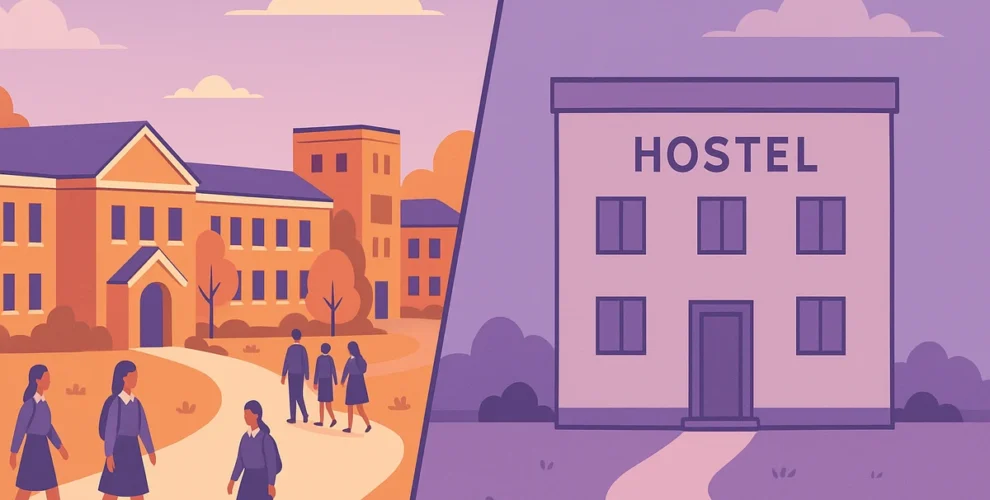
Many parents in Haryana and Delhi NCR use the words “boarding school” and “hostel” as if they mean the same thing. They do not. The confusion is understandable: both involve a child living away from home, both involve a warden or house parent, and both show up in the same Google searches. But the two are structurally, academically, and financially different institutions, and choosing between them without understanding that difference can shape a child’s entire school experience.
This guide breaks down exactly what separates a boarding school from a hostel, where the overlap genuinely exists, and how to evaluate which model fits your child, using GD Goenka International School, Sonepat’s own residential programme as a working example throughout.
Quick Answer
A boarding school is a complete, self-contained educational institution where academics, residential life, meals, health care, sports, and co-curricular activities are all designed and run by one school under one philosophy. A hostel is usually a standalone residential facility, often attached to a day school or run independently near a college or coaching hub, that provides lodging and food but does not own or design the academic programme. In a boarding school, the residence is built around the curriculum. In a hostel, the residence exists beside a curriculum that belongs to someone else.
Table of Contents
- What Is a Boarding School?
- What Is a Hostel?
- The Core Structural Difference
- Supervision and Duty of Care
- Academic Integration vs Academic Separation
- Daily Routine Comparison
- Cost Structure: What You Are Actually Paying For
- Safety, Health, and Emergency Response
- Social and Emotional Development
- Which One Suits Which Family?
- GD Goenka Sonepat’s Boarding Model
- Frequently Asked Questions
1. What Is a Boarding School?
A boarding school is an educational institution where children live on campus for most or all of the academic term. The school is responsible for the child’s academics, residential supervision, meals, health, safety, and structured co-curricular life, typically under one unified administration. Boarding schools in India generally fall under CBSE, ICSE, or IB affiliation and are subject to the same academic inspection and compliance standards as any day school, plus additional residential-care obligations.
The defining feature is integration. A boarding school’s timetable, house system, meal planning, medical staffing, and extracurricular calendar are all designed together by the same institution that teaches the child in class. A house parent at a boarding school typically has visibility into a student’s academic performance, attendance pattern, and personal wellbeing, because the residential and academic systems talk to each other.
Examples of established Indian boarding schools include The Doon School in Dehradun, Mayo College in Ajmer, and Woodstock School in Mussoorie, each a full residential institution where the school itself is the sole authority over both education and residential life. GD Goenka International School, Sonepat operates on the same integrated model, combining a CBSE-affiliated day and boarding programme within a single Sonepat, Haryana campus (see our full comparison in Top Boarding Schools in India).
2. What Is a Hostel?
A hostel, by contrast, is primarily a lodging and food-service arrangement. It can be:
- A hostel attached to a day school, housing a smaller subset of out-station students separately from the main day-scholar population
- An independent hostel near a college, university, or coaching centre (common near Kota, Delhi University North Campus, or IIT-coaching hubs), where the hostel operator has no involvement in what the student studies
- A private PG-style hostel that simply rents rooms and provides meals, with minimal structured supervision beyond basic security
The critical distinguishing feature of a hostel is separation. The people who run the hostel are often not the people who run the classroom. A hostel warden manages room allocation, meal timing, and basic discipline, but has limited or no visibility into academic performance, and usually no authority to adjust a student’s routine around exam schedules, sports commitments, or co-curricular obligations, because those belong to a different institution entirely.
This is not necessarily a negative: hostels serve a real and useful purpose, particularly for older students (college-age, or coaching-centre students) who need independent lodging near an institution that itself has no residential wing. But it is a fundamentally different service than what a boarding school provides for a school-age child.
3. The Core Structural Difference
| Factor | Boarding School | Hostel |
|---|---|---|
| Administration | Single institution runs academics + residence | Residence and academics run by separate entities |
| Academic ownership | School designs curriculum and residential life together | Hostel has no control over academic curriculum |
| Typical age group | School-age children (Grade 6 and above, commonly) | Mostly college-age or coaching-centre students |
| Regulatory oversight | CBSE/ICSE/IB affiliation covers both academic and residential norms | Regulatory oversight varies; often minimal beyond basic safety codes |
| House/warden system | Integrated with school’s pastoral care structure | Independent of any school pastoral system |
| Co-curricular access | Built into daily residential schedule | Not typically provided; student must arrange separately |
This table is the single most useful reference point for parents comparing the two. If a facility cannot answer “who designs the academic timetable and who designs the residential timetable, and are they the same people,” it is functioning as a hostel, regardless of what marketing material calls it.
4. Supervision and Duty of Care
For school-age children, the level and nature of supervision is the most consequential difference between the two models.
In a genuine boarding school, house parents (sometimes called wardens, but functioning in a more comprehensive pastoral role) are typically full-time residential staff who live on or near campus, know the students by name, track attendance and wellbeing daily, and coordinate directly with subject teachers and the school counsellor when a student is struggling academically or emotionally. Medical care is usually staffed on-site or on-call, integrated with the school’s own health protocols rather than outsourced to an external clinic with no context on the child’s history.
In a hostel, supervision is typically more transactional: room checks, meal-time headcounts, curfew enforcement, and basic security. This can be entirely adequate for an 18-year-old college student living semi-independently, but it is a materially lower level of duty of care for an 11-year-old in Grade 6.
For parents evaluating any residential programme, the concrete questions to ask are:
- Is there a resident house parent, and what is the student-to-house-parent ratio?
- Is there on-site or on-call medical staff, and what is the protocol for a night-time medical issue?
- Does the residential staff communicate directly with academic staff about a student’s progress?
- Is there a structured process for a parent to reach the school in an emergency, at any hour?
A well-run boarding school will have clear, specific answers to all four. A hostel’s answers, honestly given, will usually be thinner on the third question in particular, because academic and residential functions are not the same organisation.
5. Academic Integration vs Academic Separation
This is where the boarding school model earns its cost premium, and where families sometimes underestimate the difference until it becomes an actual problem.
In a boarding school, the evening study period (commonly called “prep” or supervised self-study) is designed by the same institution setting the day’s coursework, so it is genuinely aligned with what the child needs to revise. Subject teachers are frequently available for evening doubt-clearing sessions, either in person or through a scheduled office-hours system. Exam periods trigger adjusted residential schedules (extended library hours, modified meal timing, reduced co-curricular load) because the academic and residential calendars are the same calendar.
In a hostel, prep time (if it exists at all) is generic self-study time with no subject-specific support, because the hostel staff are not teachers and have no access to the student’s coursework or exam schedule. A student in a hostel attached to a day school, or living independently near a coaching centre, is expected to manage academic support entirely outside the residential structure.
For a family choosing residential education specifically to improve academic outcomes (rather than purely for logistics, for instance a family living too far for a daily commute), this integration is usually the deciding factor. Our guide on Day Boarding vs Full Boarding goes deeper into how residential structure interacts with academic performance for younger students specifically.
6. Daily Routine Comparison
A representative boarding school day (illustrative, based on typical CBSE-affiliated residential school structures):
| Time | Activity |
|---|---|
| 6:00 AM | Wake-up, physical training / yoga |
| 7:00 AM | Breakfast |
| 8:00 AM to 2:30 PM | Academic classes |
| 3:00 PM to 5:00 PM | Sports, co-curricular clubs |
| 5:30 PM | Tea/snacks |
| 6:00 PM to 7:30 PM | Supervised evening prep (subject-aligned) |
| 8:00 PM | Dinner |
| 8:45 PM to 9:30 PM | Free time / house activities |
| 10:00 PM | Lights out (junior boarding), staggered for seniors |
A representative hostel day (illustrative, for a college-age or coaching-centre resident):
| Time | Activity |
|---|---|
| Wake-up | Self-managed, no institutional wake-up call |
| Meals | Fixed meal windows, no coordination with academic schedule elsewhere |
| Daytime | Student attends classes/coaching off-site, entirely outside hostel’s involvement |
| Evening | Free/self-study time, no subject-specific supervision |
| Curfew | Fixed entry/exit time, enforced independently of academic calendar |
The structural gap is visible immediately: a boarding school’s day is built around the child’s development as a whole person across a single institutional philosophy. A hostel’s day is built around logistics: a place to sleep and eat between activities the student manages elsewhere.
7. Cost Structure: What You Are Actually Paying For
Boarding school fees are typically higher than hostel-only lodging costs, and understanding why matters more than simply comparing headline numbers.
Boarding school fees generally bundle: tuition, residential accommodation, all meals, health/medical cover, sports and co-curricular access, house-system pastoral care, and often transport and uniform costs. A single consolidated fee reflects a single consolidated service.
Hostel costs are typically lodging and food only: tuition (if the student is enrolled at a separate day school or coaching institute) is a completely separate line item paid to a different institution. A parent comparing “hostel fees” against “boarding school fees” without accounting for this is not making an apples-to-apples comparison; they are comparing a partial cost against a full cost.
When evaluating cost, ask any residential programme for an itemised breakdown: what is covered under the quoted fee, and what will be billed separately (uniforms, transport, exam fees, optional co-curricular add-ons, medical emergencies beyond routine care). A boarding school with transparent, itemised fee disclosure (matching the standard CBSE Mandatory Disclosure format) is a stronger trust signal than a single bundled number with no breakdown. GD Goenka Sonepat publishes its fee structure and CBSE affiliation details (affiliation no. 531123) through its Mandatory Disclosure page, in keeping with CBSE’s public disclosure norms.
8. Safety, Health, and Emergency Response
Because a boarding school’s residential and academic operations sit under one administration, safety protocols tend to be more centralized and auditable: a single security policy applies to the whole campus, a single medical team is briefed on every resident student’s health history, and a single emergency-contact chain reaches both academic and residential staff simultaneously.
In a hostel, particularly an independent hostel unaffiliated with any school, safety standards can vary considerably by operator, and there is often no requirement to maintain the kind of coordinated medical/academic record that a CBSE-affiliated boarding school maintains as part of its compliance obligations.
Parents should specifically verify, for any residential option:
- CCTV coverage and perimeter security (common areas, not private spaces)
- Fire safety compliance and evacuation drills
- Ratio of resident staff to students, especially overnight
- Medical response time and nearest hospital tie-up
- Background verification process for all residential staff
A boarding school under CBSE affiliation is subject to periodic inspection covering many of these points as part of its overall school compliance, which is a meaningful structural advantage over an unaffiliated hostel operating with no equivalent external check.
9. Social and Emotional Development
Boarding schools are explicitly designed around a house system: students are grouped into houses that compete in sports, cultural events, and academics, creating a structured peer community with built-in mentorship from senior students and house parents. This is deliberate pastoral-care architecture, not an incidental byproduct of shared accommodation.
Hostels generally do not have an equivalent structured social system. Residents may form organic friendships, but there is no institutional design behind fostering mentorship, inter-house competition, or a sense of belonging tied to school identity. For a child transitioning away from home for the first time, particularly in the middle school or early high school years, this structural difference in social scaffolding is significant: a house system gives a child an immediate, designed community, while a hostel leaves community-building to chance.
10. Which One Suits Which Family?
A boarding school is generally the right fit when:
– The child is school-age (broadly Grade 6 through Grade 12) and needs an integrated academic-residential environment
– Parents want a single institution accountable for both learning outcomes and wellbeing
– The family values structured pastoral care, house-system mentorship, and co-curricular breadth
– Location (a posting overseas, a remote family base, or long-distance logistics) makes daily commuting impossible
A hostel is generally the right fit when:
– The student is college-age or attending a coaching institute that has no residential wing of its own
– The student needs independent, semi-autonomous living rather than structured pastoral care
– Academic support is being separately arranged (through the coaching institute, tutors, or the day school itself)
– Cost efficiency for lodging-only needs is the priority, with academics handled entirely elsewhere
Confusing the two, enrolling a school-age child in what is functionally a hostel and expecting boarding-school-level academic integration and pastoral care, is the most common and most costly mistake parents make in this decision. Read our companion guide on When Is the Right Age to Send Your Child to a Boarding School for a deeper look at age-appropriate readiness.
11. GD Goenka Sonepat’s Boarding Model
GD Goenka International School, Sonepat operates as a fully integrated boarding school, not a hostel-attached day school. The residential programme is built directly around the CBSE-affiliated academic calendar (affiliation no. 531123), meaning house parents, subject teachers, and the school’s medical staff coordinate as part of one administration rather than as separate vendors.
Specific features of the model include a house system with resident house parents, supervised evening prep aligned to the day’s coursework, on-campus medical staffing, GPS-tracked transport for day scholars, and a co-curricular calendar (including sports such as fencing and shooting, and creative programmes spanning music and dance) that is scheduled as part of the same residential day, not bolted on separately. For families comparing structured CBSE options in the region, our guide on CBSE vs ICSE vs IB in Haryana and our ranking of Top 10 CBSE Schools in Sonepat provide additional context on how the school’s academic track compares locally.
Parents evaluating boarding options in Sonepat, Haryana, or the wider Delhi NCR region can review admission timelines and eligibility on the school’s Admission page, or explore the full residential programme on the Boarding page.
For general reference on how residential school standards are documented and inspected in India, the CBSE official affiliation portal and the Ministry of Education, Government of India publish current regulatory frameworks for school affiliation and compliance.
12. Frequently Asked Questions
Is a boarding school more expensive than a hostel?
Usually yes, in headline terms, but the comparison is not equivalent. Boarding school fees bundle tuition, accommodation, meals, health cover, and co-curricular access under one institution. Hostel fees typically cover lodging and food only, with tuition paid separately to a different institution. Compare itemised total costs, not headline numbers alone.
Can a hostel provide the same level of care as a boarding school for a school-age child?
Not typically. A hostel’s staff generally have no access to or authority over a student’s academic schedule, and supervision tends to be more transactional (room checks, curfews) than the integrated pastoral care a boarding school’s house system provides.
At what age should a child move into a boarding school rather than staying at a day school?
This depends heavily on the individual child’s maturity and family circumstances; there is no single correct age. Most Indian boarding schools, including GD Goenka Sonepat, accept boarding students from Grade 6 onward. See our detailed guide on the right age for boarding school for a fuller framework.
Does GD Goenka Sonepat operate as a boarding school or a hostel?
GD Goenka International School, Sonepat is a fully integrated CBSE-affiliated boarding school. Academics and residential life are designed and administered by the same institution, not outsourced to a separate hostel operator.
Is CBSE affiliation different for boarding schools versus day schools?
No, CBSE affiliation criteria apply to the school’s academic operation regardless of whether it offers boarding. However, a boarding school’s affiliation compliance also extends to residential safety and infrastructure norms that a pure day school does not need to meet.
What should I ask before enrolling my child in any residential programme?
At minimum: who designs the academic and residential schedules (same institution or different), the student-to-house-parent ratio, on-site medical staffing and emergency protocol, an itemised fee breakdown, and the school’s CBSE (or relevant board) affiliation number for independent verification.
Are all “hostels” attached to schools lower quality than boarding schools?
Not inherently lower quality, but structurally different. A well-run hostel attached to a school can still provide reasonable supervision; the key distinction is whether the hostel staff have real coordination with academic staff, or whether the two operate as separate silos. Ask the specific coordination questions above rather than assuming based on the label alone.
This article is for general guidance. For current fee structures, CBSE affiliation details, and admission timelines specific to GD Goenka International School, Sonepat, please refer to the school’s official Admission page or contact the admissions office directly.
Ready to explore residential admissions? Visit the Admissions page or the Boarding programme page at GD Goenka International School, Sonepat.