

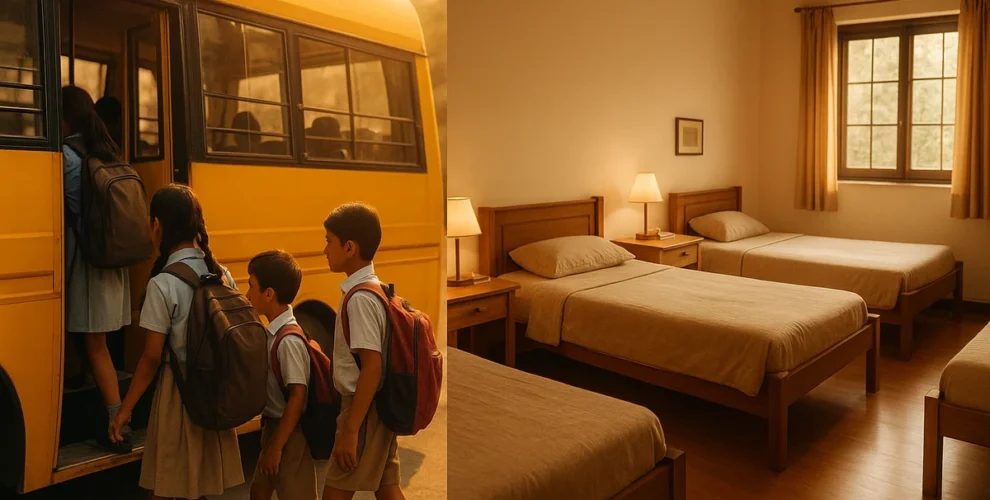
For many Haryana and Delhi-NCR parents, “boarding school” conjures a single image — a child living away from home full-time. But the modern schooling landscape offers a genuine middle option: day boarding, which combines structured, supervised school hours with the child returning home every evening. Understanding the real differences between day boarding and full (residential) boarding — beyond just the marketing language — is essential before making a decision that affects your child’s daily life and development.
This guide compares the two formats plainly, covering academics, independence-building, cost, and the practical question every parent eventually asks: which is actually right for my child?
For Haryana and Delhi-NCR families specifically, this choice is increasingly common as more schools in the region — including day-boarding and full-boarding options in Sonepat — expand beyond the traditional day-school-only model.
What Is Day Boarding?
Day boarding extends the traditional school day into a structured, supervised block — typically including lunch, a rest/study period, homework supervision, and sometimes evening activities — before the child goes home in the evening. It sits between a standard day school and full residential boarding, giving working parents structured after-school supervision without the child living away from home.
What Is Full Boarding?
Full (residential) boarding means the child lives on campus in a dedicated hostel/dormitory facility, typically returning home only during scheduled breaks, long weekends, or vacations, depending on the school’s policy. Full boarding schools provide complete daily-living infrastructure: dormitories, dining halls, resident medical staff, and structured evening/weekend programming.
Side-by-Side Comparison
| Factor | Day Boarding | Full Boarding |
|---|---|---|
| Where the child sleeps | At home, every night | On campus, in a hostel/dormitory |
| Supervision hours | Extended school day (structured, supervised) | 24/7 on-campus supervision |
| Independence-building | Moderate — structured hours away from home | High — full daily-living independence |
| Parent involvement in daily routine | High — evenings/nights at home | Lower day-to-day, higher during scheduled visits/breaks |
| Cost | Lower than full boarding | Higher — covers accommodation, meals, and residential staffing |
| Best for | Working parents needing structured after-school hours; younger children not yet ready to live away | Families seeking full independence-building; children who thrive in structured communal living; families relocating or with demanding work travel |
| Typical starting age | Any age, including primary grades | Typically better suited from upper-primary/middle school onward |
| Home-school separation | Minimal — child is home nightly | Meaningful — requires child readiness for time away |
Academic Impact: Does One Format Perform Better?
Academic outcomes depend far more on the individual school’s teaching quality, teacher-student ratios, and curriculum delivery than on the boarding format itself. That said, each format offers a distinct academic environment:
- Day boarding provides structured, supervised homework/study time during the extended school day, which can meaningfully reduce the burden on parents managing evening academics — while the child still benefits from home routines and family presence at night.
- Full boarding typically offers longer structured study blocks (evening prep sessions supervised by resident staff), which can benefit students who need consistent, distraction-managed study environments, particularly during senior secondary years with board-exam pressure.
Neither format is inherently academically superior — the deciding factor should be which environment better supports your specific child’s study habits and independence level.
Independence and Emotional Readiness
This is often the single most important factor in the decision, and one many parents underweight relative to academics or facilities.
Day boarding is a lower-stakes way to build structured-time independence — children learn to manage a longer, more demanding school day with less parental hand-holding, while still coming home to family support each evening. This makes it a reasonable stepping stone for children not yet emotionally ready for full residential life, or for younger children where nightly parental presence still matters developmentally.
Full boarding requires genuine readiness — not just academic maturity, but the emotional capacity to manage daily-living independence (personal organisation, peer conflict resolution, homesickness) without a parent present each night. Most educators recommend evaluating this readiness honestly around upper-primary age onward, rather than assuming a fixed “right age.” For a deeper look at readiness signals and timing, see our companion guide on choosing the right age for boarding school.
Cost Considerations
Full boarding is meaningfully more expensive than day boarding, since fees must cover accommodation, meals, resident staffing (including medical and warden supervision), and residential infrastructure maintenance — costs a day boarding programme simply doesn’t carry. When comparing schools, always request an itemised fee breakdown rather than relying on a single headline number, since “boarding fee” packages vary widely in what they actually include (uniforms, transport, activity fees, and medical cover are common variables).
How GD Goenka Sonepat Approaches Both Formats
GD Goenka International School, Sonepat offers both day-boarding and full residential boarding for boys and girls, allowing families to choose the format that fits their child’s readiness and their own logistical needs — and to discuss transitioning between formats if circumstances change. The residential boarding facilities include dedicated dormitories, on-campus medical staffing, and structured evening study and activity programming. Visit our boarding facilities page for details, or our admissions page to begin the enquiry process.
Questions to Ask Before Deciding
Regardless of which format you’re leaning toward, ask any shortlisted school:
- What is the actual student-to-supervisor ratio during boarding/extended hours?
- What is the resident medical staffing structure (for full boarding)?
- How are homesickness and adjustment issues handled in the first month?
- What is the exact daily/weekly schedule — request it in writing, not verbally.
- Can a child transition from day boarding to full boarding (or vice versa) mid-year if needed?
A Week in Each Format — What Actually Changes
It helps to picture the practical, day-to-day difference rather than compare the formats only in the abstract.
A typical day-boarding week: a child leaves home each morning, attends regular classes, stays on campus through an extended structured block (lunch, supervised study, extracurricular activity), and is picked up or bused home in the evening — sleeping in their own bed every night, with weekends entirely at home with family, same as a conventional day school.
A typical full-boarding week: a child wakes on campus, attends classes, participates in structured evening study and activity programming, and follows a consistent residential routine managed by hostel/warden staff — with time at home typically limited to scheduled weekend visits (where the school’s policy allows), long weekends, or vacation breaks, depending on the specific school’s calendar.
Neither routine is inherently better — the question is which rhythm suits your child’s temperament, your family’s weekly availability, and your longer-term goals for building independence.
Common Parent Concerns, Addressed Honestly
“Will my child feel abandoned in full boarding?” This is one of the most common anxieties, and it is a legitimate one to take seriously rather than dismiss. The honest answer is that initial adjustment — including some homesickness — is normal and expected in the first few weeks, even for children who are otherwise ready. What matters most is the school’s structured support system during this period: how staff monitor emotional adjustment, how communication with parents is facilitated in the early weeks, and whether the school has an established, described process for this transition rather than a vague reassurance.
“Is day boarding just a fancier day school?” Not quite — the meaningful difference is the structure of the extended hours. A good day-boarding programme provides genuinely supervised study time and activity structure during those extra hours, rather than simply extending the school day without added value. When evaluating a day-boarding programme, ask specifically what is different about the extended-hours block compared to a normal after-school routine at home.
“Can we try full boarding and switch back if it doesn’t work?” Most schools that offer both formats — including GD Goenka Sonepat — can discuss a transition between day-boarding and full boarding if family circumstances or a child’s readiness changes. This flexibility is worth asking about explicitly before enrolling, since not every school structures its admission process to accommodate mid-session changes easily.
What to Physically Check During a Campus Visit
Before committing to either format, a campus visit should go beyond a guided tour. For full boarding specifically, ask to see (not just hear about):
- The actual dormitory rooms your child would live in, including washroom facilities
- The dining hall during an actual mealtime, if possible
- The on-campus medical facility and ask about resident medical staffing hours
- The evening study/prep hall in use, if your visit timing allows
For day boarding, focus instead on the extended-hours supervision structure — ask to observe (or get a detailed walkthrough of) the actual supervised study block, not just the regular classroom day.
Frequently Asked Questions
Q: What is the main difference between day boarding and full boarding?
A: Day boarding extends the school day with structured supervision but the child returns home every evening; full boarding means the child lives on campus in a residential hostel facility, typically returning home only during scheduled breaks.
Q: Is day boarding a good stepping stone before full boarding?
A: Yes — many parents use day boarding to help a child build structured independence and comfort with an extended school routine before considering a transition to full residential boarding later.
Q: At what age should a child start full boarding school?
A: There is no single fixed age; readiness depends on emotional maturity and independence, though most educators suggest evaluating full boarding from upper-primary/middle school onward. See our detailed guide on the right age for boarding school.
Q: Is full boarding significantly more expensive than day boarding?
A: Yes, generally — full boarding fees cover accommodation, meals, and residential staffing that day boarding does not require, so it typically carries a materially higher fee structure. Always request an itemised breakdown from the specific school.
Q: Does GD Goenka Sonepat offer both day boarding and full boarding?
A: Yes, GD Goenka International School, Sonepat offers both day-boarding and full residential boarding options for boys and girls. Visit our boarding page for details.
Q: Can a child switch from day boarding to full boarding later?
A: Many schools allow this transition, though policies vary — ask your shortlisted school directly about mid-year or mid-session transition options before enrolling.
GD Goenka International School, Sonepat offers both day-boarding and full residential boarding for boys and girls on its Khewra, Sonepat campus. Explore our boarding facilities or start your admissions enquiry today.