

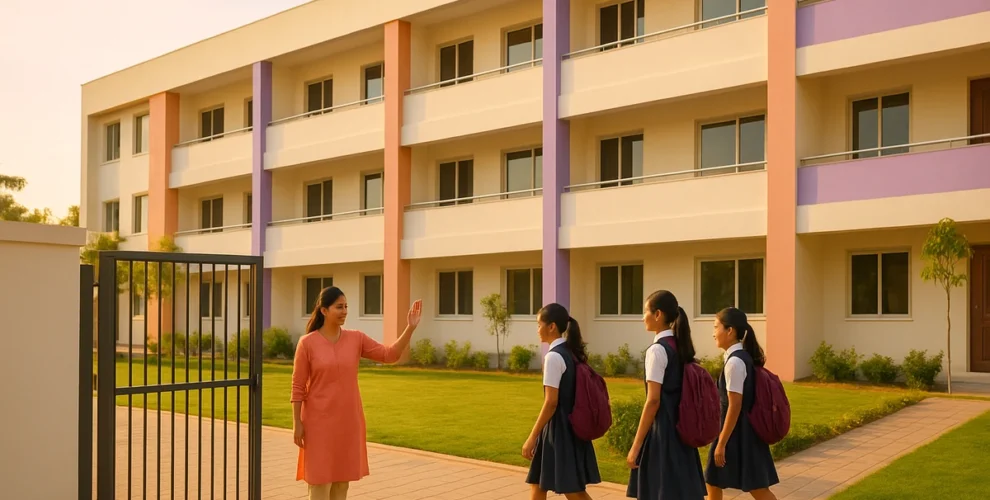
When parents in Delhi NCR and across Haryana start shortlisting boarding schools for their daughters, the search almost always begins with one word: safety. Academic rankings, sports facilities and campus size matter, but for a girl’s residential school, three things decide whether a family says yes: how safe the hostel actually is, what daily hostel life looks like, and how many teachers and wardens are watching over how many students. This guide walks through exactly what to check before you enrol your daughter in a boarding school in Haryana, and shows how GD Goenka International School, Sonepat, structures its girls’ boarding programme against each of those criteria.
This is not a generic “top 10” list copied from a directory site. It is a checklist you can use on any school’s campus visit, along with the specific, verifiable numbers for GD Goenka Sonepat so you can compare them against what any other school tells you.
Why Safety Is the First Filter, Not an Afterthought
For a day school, safety usually means transport and campus access control. For a girls’ boarding school, safety is a 24-hour commitment. Your daughter will sleep, eat, study and spend her free hours on that campus for months at a stretch. The question is not “is the campus secure” in a generic sense, it is “who is responsible for my daughter at 11 pm on a Tuesday, and what happens if she is unwell or upset.”
Before you shortlist any boarding school in Haryana for your daughter, the National Commission for Protection of Child Rights (NCPCR) has published safety and security guidelines for schools that are a useful independent benchmark, covering perimeter security, staff verification, and grievance redressal (see ncpcr.gov.in for the current guidelines). CBSE-affiliated residential schools are also expected to comply with these along with the board’s own affiliation bye-laws on hostel infrastructure. Ask any school directly whether their hostel staff undergo police verification, whether CCTV coverage extends to common areas (never inside rooms, which would violate a child’s privacy), and whether there is a woman warden physically resident in the girls’ hostel, not just on call.
GD Goenka International School, Sonepat, is CBSE affiliated (Affiliation No. 531123, School Code 41138), and the campus operates under the CBSE Mandatory Disclosure norms that require every affiliated school to publish infrastructure and safety information publicly. You can find the school’s own disclosure at the CBSE Mandatory Disclosure page on the school website, which is the same standard every parent should ask to see from any school they are considering, not just GD Goenka.
The Girls’ Hostel Safety Checklist
Use this checklist on your own school visits, whichever schools you are comparing.
- Resident woman warden and matron on every floor. A single warden for an entire hostel building is not enough supervision for younger girls. Ask how many wardens are resident per floor or per wing.
- Entry and exit logs for the hostel building, separate from the main school gate, with visitor logs cross-checked against a pre-approved list submitted by parents.
- In-house medical staff or a tie-up with a nearby hospital, with a resident nurse or doctor available on campus, not just an on-call arrangement 40 minutes away.
- A working, confidential grievance mechanism that a student can use if she is uncomfortable, separate from the academic complaint process.
- CCTV in common areas (corridors, dining hall, entrance, activity rooms), explicitly not inside dormitories or washrooms.
- Transport safety for local outings, including GPS-tracked vehicles and a woman staff escort for any off-campus trip.
- Fire safety and emergency drills conducted on a fixed schedule, with evacuation routes clearly marked in the hostel building itself, not just the classroom blocks.
- A documented policy for medical emergencies at night, since this is the single most common parent worry for a boarding school decision.
GD Goenka Sonepat’s residential wing is built around exactly this structure: a resident house-parent system with women wardens supervising the girls’ boarding houses, an on-campus medical team, and CCTV-monitored common areas. Parents evaluating the school on a campus visit should ask to walk through the girls’ hostel wing specifically and meet the warden on duty, not just tour the academic block.
What Hostel Life Actually Looks Like
Safety is the filter, but daily life is what your daughter will actually experience for months at a time. A boarding school that only talks about security and never about routine, food, and downtime is not giving you the full picture.
A well-run girls’ boarding programme typically follows a structured but not overly rigid daily rhythm:
- Morning routine: wake-up, physical activity or yoga, breakfast, and assembly before the academic day begins.
- Academic hours: standard CBSE curriculum hours, the same as a day-scholar’s timetable.
- Post-school hours: this is where boarding differs most from day schooling. Supervised prep/study time, followed by co-curricular blocks (sport, music, art, dance) that day scholars often cannot access because they have to commute home.
- Dining: a nutritionist-planned mess menu, ideally with input from a dietician, since growing girls in a residential setting need consistent, balanced meals rather than ad hoc food.
- Evening study hall: supervised prep time with subject teachers or resident tutors available for doubt-clearing, not just self-study with no support.
- Lights out and rest: a fixed, age-appropriate bedtime with a warden doing rounds.
- Weekend structure: a mix of planned excursions, free time, and communication windows with parents (video calls, phone access on a set schedule).
At GD Goenka Sonepat, the boarding programme is structured around this same rhythm, with the residential campus offering supervised evening study halls, a dedicated dining facility with a planned menu, and co-curricular access (the school’s dance programme includes ballet, pilates and gyro-based training, and the music academy runs structured classes) that boarding students can use in the evenings when day scholars have already left campus. For a detailed look at how boarding routines compare to day-boarding options, see our earlier guide on day boarding vs full boarding, which breaks down exactly which families each format suits.
Communication with parents is another area where hostel life quality varies widely between schools. Ask specifically: how often can my daughter call home, is there a fixed weekly schedule, and what is the school’s policy if a parent needs to reach their daughter urgently outside that window. A school that treats parent communication as an afterthought is usually treating pastoral care as an afterthought too.
Faculty Ratio: The Number That Actually Predicts Attention
“Faculty ratio” or student-teacher ratio is one of the most quoted, and most misunderstood, numbers in school marketing. A low ratio sounds impressive on a brochure, but what matters for a boarding student is whether that ratio holds up outside the classroom too, during evening study hall, in the hostel, and in small-group mentoring.
According to GD Goenka Sonepat’s own CBSE Mandatory Disclosure, the school reports a student-teacher ratio of approximately 1:15 at the primary level and around 25:1 at the senior level, with a total teaching staff of 32 at the primary section and 34 at the secondary section. These are the school’s own disclosed figures, not marketing claims, and any parent can ask to see the equivalent disclosure from any other school they are comparing.
Why does this number matter more for a boarding student than a day scholar? A day scholar goes home every evening to parental attention. A boarding student’s only source of one-on-one academic and emotional attention, outside class hours, is the residential staff and evening-hall teachers. A school with a strong classroom ratio but thin evening supervision is not actually delivering on the promise a low faculty ratio implies. When you visit a school, ask specifically how many staff members are present during the evening study block per number of boarding students, not just the classroom ratio during the day.
A few practical questions to ask on this point:
- What is the boarding-specific staff-to-student ratio during evening prep hours, separate from the classroom ratio?
- Are subject teachers available for doubt-clearing in the hostel in the evenings, or only during school hours?
- How many counsellors or pastoral care staff are dedicated to the residential wing?
- What is the average class size in the grade your daughter will join?
Academic and CBSE Credentials to Verify
Faculty ratio is one piece of the academic picture. Before shortlisting any boarding school in Haryana, confirm these credentials directly with the school, and cross-check them against the CBSE affiliation database at cbse.gov.in:
- CBSE affiliation number and current status (permanent, provisional, or under process). GD Goenka Sonepat’s affiliation number is 531123, school code 41138.
- Board exam results for the last three years, both Class X and Class XII, if the school has senior-secondary boarding students.
- Curriculum framework: whether the school follows a strict CBSE syllabus or supplements it with additional enrichment tracks. If you are also weighing CBSE against ICSE or IB options in Haryana, our detailed comparison is here: CBSE vs ICSE vs IB in Haryana.
- Teacher qualifications, not just headcount. Ask what percentage of the faculty holds a B.Ed or equivalent, and how long the average teacher has been with the school (staff turnover is a real, underreported quality signal for boarding schools).
Campus and Infrastructure: What to Physically Verify
Marketing brochures describe campuses in acres and square feet, and these numbers are not always consistent even on a single school’s own materials. The only figure a parent should treat as authoritative is the one filed in the school’s CBSE Mandatory Disclosure, since that is a regulatory filing rather than a promotional claim. GD Goenka Sonepat’s Mandatory Disclosure lists a built-up campus area of 28,327 square metres, which any parent can verify directly from the disclosure page linked above.
On a physical visit, walk through:
- The girls’ hostel building specifically, not just a “sample room” set up for tours.
- The dining hall during an actual meal service, not an empty showcase.
- The medical room or infirmary, and ask to meet the resident medical staff.
- The library and study spaces available to boarders in the evening.
- The sports and co-curricular facilities boarders can access after academic hours, since day scholars typically cannot use these in the evening.
For a broader parent-facing walkthrough of how to evaluate any boarding school in the NCR region, our earlier guide on choosing the best boarding school in NCR covers the general decision framework that this article builds on for the girls-specific safety and hostel lens.
Questions to Ask on Every Campus Visit
Print this list and take it with you, whichever schools you are comparing:
- How many resident women wardens supervise the girls’ hostel, and what is the warden-to-student ratio at night?
- What is the protocol if my daughter is unwell after the school medical staff have left for the day?
- How often can I call or video-call my daughter, and is there an emergency contact line that reaches a real person at any hour?
- Can I see the CBSE Mandatory Disclosure for infrastructure, safety and staff qualifications?
- What percentage of hostel staff have undergone police verification, and how recently was it renewed?
- What happens during a fire drill, and when was the last one conducted?
- Is there a written, confidential process for a student to report discomfort or a grievance?
- What is the boarding-specific staff ratio during evening study hours, separate from daytime class ratios?
- Can I meet current boarding parents, not just the admissions team, to ask about their experience?
- What is included in the boarding fee, and what is billed separately (uniforms, transport, medical, extracurricular)?
A school that answers all ten of these directly and specifically, with numbers rather than general reassurance, has almost certainly built genuine systems around them. A school that gives vague answers to more than two or three of these questions is worth a second, harder look before you commit.
How GD Goenka Sonepat Answers This Checklist
To bring this back to a concrete example rather than an abstract framework, here is how GD Goenka International School, Sonepat, answers the checklist above, using only the school’s own publicly disclosed and verifiable figures:
- CBSE affiliation: 531123, school code 41138, verifiable on the CBSE affiliation portal.
- Student-teacher ratio: approximately 1:15 at primary level, around 25:1 at senior level, with 32 teaching staff at primary and 34 at secondary, per the school’s own Mandatory Disclosure.
- Campus: 28,327 square metres of built-up campus area, located in Kundli, Sonepat, Haryana, within the Delhi NCR belt, making it accessible for both boarding families from across India and day-scholar families from Delhi and NCR.
- Girls’ hostel supervision: resident house-parent and warden system for the girls’ boarding wing, with on-campus medical support.
- Co-curricular access: a structured dance programme (including ballet, pilates and gyro-based training), a music academy, and sports facilities that boarding students, including girls, can access in supervised evening blocks.
- Location advantage: proximity to Delhi NCR means that boarding families can visit more easily than a boarding school located deep in a hill station, which matters for parents who want a boarding education without the distance of a school several states away.
This is deliberately not a claim that GD Goenka Sonepat is objectively “the best” school in Haryana in a way that overrides your own campus visit and comparison. It is a demonstration of the level of specific, checkable detail you should demand from any school you are considering for your daughter’s boarding education, and an honest account of where GD Goenka Sonepat stands against its own published numbers.
If you are comparing GD Goenka Sonepat against other boarding options more broadly across India, not only within Haryana, our earlier comparison piece is a useful starting point: Top Boarding Schools in India. For families still deciding whether boarding is the right choice at all for their daughter’s age and temperament, see when is the right age to send your child to a boarding school, and for families in the immediate Sonepat catchment weighing day school against boarding, Best Schools in Sonipat: A Parent’s Guide covers the local landscape.
What Parents Consistently Get Wrong When Comparing Boarding Schools
A few recurring mistakes show up when parents shortlist boarding schools for their daughters, worth naming directly:
Judging safety by the campus wall, not the hostel system. A high boundary wall and a security guard at the gate is baseline infrastructure, not a hostel safety programme. The real signal is staff supervision ratios, grievance mechanisms and medical response time, which are much harder for a school to fake and much easier to verify with direct questions.
Comparing acreage instead of built infrastructure actually used by boarders. A large campus with most of its area as undeveloped land tells you little about hostel quality. Ask what proportion of the campus is dedicated to residential facilities specifically, not just total acreage.
Treating “girls’ wing” as a footnote in a co-ed school’s marketing. In a co-ed residential school, ask direct questions about how the girls’ hostel is staffed, supervised and physically separated from the boys’ wing, rather than assuming general campus safety measures automatically extend equally to the boarding side.
Not asking about staff turnover. A young, transient hostel staff is a real quality signal parents often skip. Longer-tenured wardens and house-parents generally build stronger, more trusted relationships with boarding students over a full academic year.
Skipping the CBSE Mandatory Disclosure entirely. Every CBSE-affiliated school is required to publish this. It is the single fastest way to separate marketing language from filed, regulatory fact, and reading it before your campus visit means you can ask sharper, more specific questions when you get there.
A Quick Reference Table for Campus Visits
Keep this simple table on hand when you visit any boarding school in Haryana. Fill in each school’s answer and compare side by side once you have visited two or three campuses.
| What to check | Why it matters for a girls’ boarding school | GD Goenka Sonepat’s own disclosed figure |
|---|---|---|
| CBSE affiliation number | Confirms the school is regulated and can be independently verified | 531123, school code 41138 |
| Primary student-teacher ratio | Predicts classroom attention for younger boarders | Approximately 1:15 |
| Senior student-teacher ratio | Predicts attention as academic pressure increases | Approximately 25:1 |
| Teaching staff count | Cross-checks the ratio claim against actual headcount | 32 primary, 34 secondary |
| Campus built-up area | Regulatory figure, not a marketing acreage claim | 28,327 square metres |
| Girls’ hostel supervision model | Direct answer to who is responsible for your daughter overnight | Resident house-parent and warden system |
| Medical support on campus | Determines emergency response speed | On-campus medical team |
| Evening co-curricular access | Shows whether boarders get more than day scholars, not less | Dance (ballet, pilates, gyro training), music academy, sports |
Use the same table format for every school you visit. If a school cannot produce a comparable answer for even two or three of these rows within a day of asking, that is itself useful information.
Why Location Within Haryana Still Matters for Safety
Not every boarding school in Haryana sits in the same context, and location has a real, practical bearing on safety beyond the campus gate itself. A school located within the Delhi NCR belt, close to a major highway and within reasonable distance of multi-specialty hospitals, gives parents a materially different risk profile than a campus in a remote rural stretch with the nearest advanced medical facility an hour or more away. This is not a claim that rural campuses are unsafe, many are excellent, but it is a factor worth weighing consciously rather than overlooking.
GD Goenka Sonepat sits in Kundli, Sonepat, directly on the Delhi NCR edge, which means parents from Delhi, Gurugram, Noida and neighbouring Haryana towns can reach the campus for a visit, a pickup, or an emergency in under two hours in most cases. For families evaluating a residential school specifically because they want boarding structure without placing their daughter at a multi-state distance from home, this proximity is a meaningful, practical safety factor in addition to everything covered in the checklist above.
It is also worth asking any school directly what their tie-up hospital is, how far it is from campus, and whether the school has ever needed to use that emergency pathway. A school that has thought this through will have a specific, rehearsed answer rather than a general reassurance.
A Final Word for Parents
Choosing a boarding school for your daughter is not a decision to make from a website alone, whichever school you are considering, including GD Goenka Sonepat. Use the checklist in this article on every campus visit, ask the ten questions listed above directly to the admissions team and to the warden on duty, and cross-check every safety and infrastructure claim against the school’s CBSE Mandatory Disclosure. A school confident in its own systems will welcome those questions rather than deflect them.
For families ready to take the next step, GD Goenka Sonepat’s admissions page has the current application process and timeline for the 2026-27 academic year, and the boarding programme page has further detail on the residential structure described in this guide. Prospective parents are also welcome to request a campus visit specifically to the girls’ hostel wing before making a final decision, which is the single most useful step in this entire process.
Sources referenced: CBSE Mandatory Disclosure norms and affiliation portal (cbse.gov.in), National Commission for Protection of Child Rights school safety guidelines (ncpcr.gov.in), and GD Goenka International School, Sonepat’s own CBSE Mandatory Disclosure page. All GD Goenka Sonepat figures cited (affiliation number, school code, student-teacher ratio, staff counts, campus area) are drawn directly from the school’s published Mandatory Disclosure and are current as of this article’s publication date.